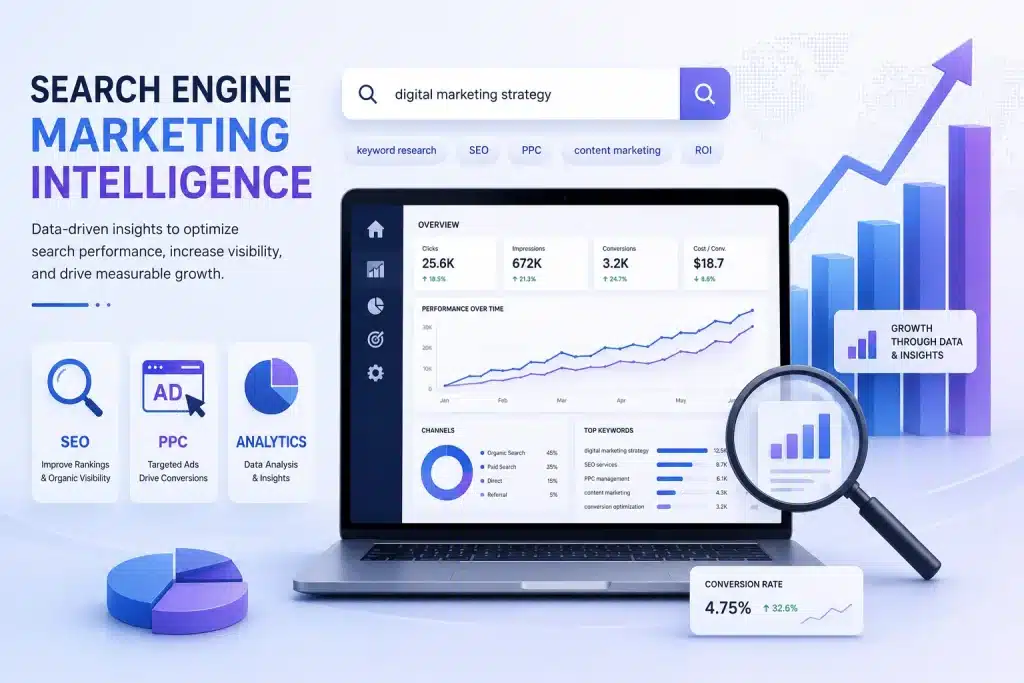
Search engine marketing intelligence is the practice of collecting and analysing search data — keyword, SEO, paid search, competitor and conversion data — and using it to decide which keywords to target, where to spend budget, what content to create and how to improve conversions. It connects what people search for with what actually produces leads and sales.
Most businesses already have more of this data than they use. Google Search Console, Google Ads, analytics and competitor tools all show what people search for, what they click and what makes them convert. This guide explains what SEM intelligence includes, how it differs from related terms such as SEO intelligence and search marketing analytics, which data sources matter, and a practical five-step framework for turning search data into better decisions.
Key takeaways
- SEM intelligence connects SEO and PPC data so each channel makes the other smarter.
- Your most valuable source is your own data: Search Console queries, ad search terms and conversion tracking.
- Use it to find winning keywords, cut wasted spend, close content gaps and improve landing pages.
What Is Search Engine Marketing (SEM)?
Search engine marketing is the umbrella term for getting visibility in search engines. People use it in two ways:
- Broad meaning: all search marketing, both organic (SEO) and paid (PPC).
- Narrow meaning: paid search only, such as Google Ads and Microsoft Ads.
In this guide we use the broad meaning, because the real advantage comes from treating organic and paid search as one system.
What Is Search Engine Marketing Intelligence?
SEM intelligence is the process of collecting, analysing and acting on search data to decide which keywords to target, where to spend budget, what content to create and how to improve conversions. Instead of guessing, every decision is based on how real people search and behave.
In practice, it combines four kinds of insight:
- Search intent: what the searcher is trying to do: learn, compare or buy.
- Keyword and query data: the words people use, how often, and which ones already bring you impressions or clicks.
- Competitive search analysis: which competitors appear for your priority searches, and with which pages, ads and messages.
- Conversion data: which searches and landing pages turn visitors into enquiries, bookings or sales.
SEM Intelligence vs SEO Intelligence vs Search Analytics
These terms overlap and are often used interchangeably. The useful distinction is that analytics describes what happened, while intelligence turns that data into the next decision.
| Term | Focus | The question it answers |
|---|---|---|
| Search engine marketing intelligence | SEO and paid search together | Where should our next search budget and content effort go? |
| SEO intelligence | Organic search | Which pages and topics can realistically rank, and what is holding them back? |
| Search engine marketing analytics | Measuring performance | What did our search traffic and campaigns actually deliver? |
| Competitive search intelligence | Competitors in the results | Who wins the searches we want, and how? |
SEO vs PPC: How They Work Together
| SEO (organic) | PPC (paid) | |
|---|---|---|
| Speed | Builds over months | Traffic from day one |
| Cost model | Investment in content and technical work | Pay per click |
| Longevity | Keeps delivering after the work is done | Stops when spend stops |
| Best data it gives | Long-term query trends and content gaps | Fast keyword and message testing with conversion data |
The intelligence comes from sharing data: PPC shows quickly which keywords and messages convert, so SEO can invest in them for the long term. SEO shows which topics already rank organically, so PPC can stop paying for clicks you would get anyway.
The Data Sources That Matter Most
- Google Search Console: the real queries your site appears for, with impressions, clicks, click-through rate and average position.
- Google Ads search terms report: the exact searches that triggered your ads, and which ones converted.
- Analytics and conversion tracking: what visitors do after they land: calls, forms, sign-ups and purchases.
- Keyword research tools: search volume, difficulty and related questions for new opportunities.
- Competitor research: which keywords, ads and pages competitors rely on.
- Search results themselves: what Google shows (videos, maps, FAQs, AI answers) tells you what format searchers want.
A 5-Step Framework for Using SEM Intelligence
Step 1: Track conversions properly
Without accurate conversion tracking, every other insight is guesswork. Track form submissions, calls, bookings and purchases, and make sure both analytics and ad platforms receive them.
Step 2: Find high-intent keywords
Group keywords by intent: informational (“what is QAaaS”), commercial (“best QA testing company”) and transactional (“hire QA engineers”). Prioritise commercial and transactional terms for landing pages and ads, and use informational terms for articles that build trust.
A practical SEM keyword strategy then gives each group a job: paid search tests commercial and transactional terms quickly, SEO builds lasting visibility for the terms that convert, and informational content answers the questions buyers ask earlier in their research.
Step 3: Cut waste and double down on winners
- Add negative keywords for searches that click but never convert.
- Move budget toward ad groups and keywords with the best cost per conversion.
- Find Search Console queries on page two (positions 11–20) where a better page could reach page one.
Step 4: Close content gaps
Compare the questions your customers search for with the pages you have. Every important question without a strong answer is an opportunity: a new service page, a comparison, an FAQ or a guide.
Step 5: Improve landing pages and keep testing
Match each landing page to the search intent behind the click. Test headlines, calls to action and proof points, and make sure pages are fast on mobile. Small improvements in conversion rate make both SEO and PPC more profitable.
A Simple Example
Illustrative scenario, not a client result. A B2B software company sees in Search Console that one of its guides appears on page two for a comparison query, while its Google Ads search terms report shows that similar comparison searches lead to demo requests. Search intelligence points to three actions: improve the guide so it can reach page one, test the comparison message in ads, and add a clear next step for readers who are ready to talk to sales.
Metrics to Watch
- Impressions and click-through rate: are your titles and ads compelling?
- Average position: which pages are close to page one?
- Conversion rate: are visitors taking action?
- Cost per conversion: what does each lead or sale cost in paid search?
- Organic conversions: how many leads does SEO bring in, not just visits?
Common SEM Mistakes to Avoid
- Running ads without conversion tracking
- Using broad match keywords without negative keyword lists
- Sending all ad traffic to the homepage instead of a matching landing page
- Treating SEO and PPC as separate teams with separate data
- Judging success by clicks instead of qualified leads
The Future: AI Search and Smarter Automation
AI-generated answers and automated bidding are changing search. Automation works best when you feed it accurate conversion data, and AI answers favour clear, well-structured, trustworthy content. That makes solid tracking, strong content and structured data more important than ever, which is why modern SEO increasingly includes Answer Engine Optimization (AEO) and Generative Engine Optimization (GEO).
How CloudOryx Helps
CloudOryx brings SEO, paid search and analytics together under one team. Our digital marketing and SEO services cover keyword research, conversion tracking, Google Ads management, landing page optimization and plain-language reporting. We can manage paid search alongside full SEO, and add funnel and conversion rate optimization when you’re ready to scale. Talk to our team about the right mix for your goals.
New to SEO? Start with our complete guide to SEO services.
Not sure where your search budget is going? We’ll review your SEO and ads data and show you the quickest wins.
Frequently Asked Questions
What is search engine marketing intelligence?
It is the practice of collecting and analysing search data from SEO and paid search, such as queries, clicks and conversions, to decide which keywords to target, where to spend budget and how to improve content and landing pages.
What is SEO intelligence?
SEO intelligence is the organic-search side of search intelligence: using Search Console data, rankings, competitor pages and technical audits to decide which pages to create or improve and what is holding them back.
What is search engine marketing analytics?
Search engine marketing analytics measures how search traffic and campaigns perform, using metrics such as impressions, click-through rate, conversions and cost per conversion. Intelligence builds on analytics by turning those results into decisions.
What does SEM mean in marketing?
SEM stands for search engine marketing. Broadly it covers both SEO and paid search. In a narrower sense, many people use it to mean paid search advertising such as Google Ads.
Is SEM better than SEO?
Neither is better on its own. Paid search delivers traffic quickly and is ideal for testing, while SEO builds lasting traffic. The best results come from using both and sharing data between them.
What are search engine marketing keywords?
They are the words and phrases people type into search engines that you target with content or ads. The most valuable ones show clear commercial or buying intent.
What tools are used for SEM intelligence?
Core tools include Google Search Console, Google Ads, Google Analytics and a keyword research tool, supported by competitor research and careful review of the search results themselves.